
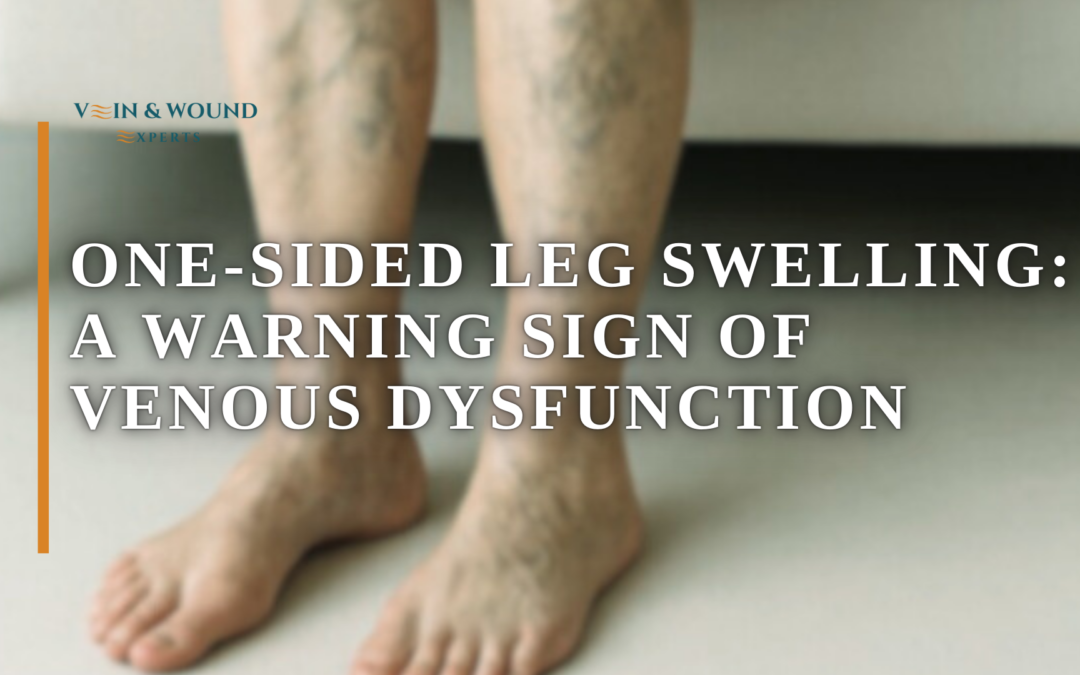
One-Sided Leg Swelling as a Warning Sign of Venous Dysfunction 🦵⚠️
Leg swelling that affects only one leg is never a random finding. From a vascular medicine perspective, asymmetry is one of the most important diagnostic clues. While temporary swelling can occur after travel or prolonged standing, persistent or recurrent swelling limited to one leg often reflects impaired venous outflow rather than a generalized fluid issue. This distinction is critical, because venous dysfunction tends to progress when left unaddressed.
Why One Leg Swells While the Other Does Not 🩺🔍
Venous circulation in each leg functions independently. When swelling appears on only one side, it usually means that blood return is compromised somewhere along that specific venous pathway. Faulty valves, venous narrowing, or post-thrombotic changes can all disrupt normal flow, causing pressure to build in the lower extremity.
Unlike bilateral swelling related to heart, kidney, or systemic conditions, one-sided symptoms point clinicians toward localized venous pathology. This is why unilateral swelling carries greater diagnostic weight and should not be dismissed as lifestyle-related discomfort.
Venous Dysfunction and Asymmetric Fluid Retention 🧬🦶
Healthy veins rely on intact valves to move blood upward against gravity. When these valves fail, blood refluxes downward and pools in the leg. Over time, this leads to fluid leakage into surrounding tissues, producing visible swelling.
In venous disease, swelling often worsens throughout the day and improves with elevation. The affected leg may feel heavier, tighter, or warmer than the other. These functional changes often appear before skin discoloration or visible varicosities, making early recognition especially important.
How Venous-Related Swelling Differs From Other Causes 🚶♂️📉
Not all swelling behaves the same way. Venous-related leg swelling follows predictable patterns that help distinguish it from orthopedic or lymphatic conditions.
• 🟢 Swelling increases after standing or walking
• 🟢 Symptoms ease when the leg is elevated
These features reflect gravity-dependent venous pressure rather than inflammation or joint injury. Muscle strains or trauma usually cause localized pain, while venous dysfunction produces diffuse swelling involving the ankle, calf, or lower leg.
Risk Factors That Increase the Likelihood of Venous Involvement 📊🧠
Certain factors raise the probability that one-sided swelling has a venous origin. Prior blood clots, prolonged immobility, pregnancy, obesity, and family history all contribute to vein wall and valve damage. Age also plays a role, as veins gradually lose elasticity, making reflux more likely.
In clinical practice across California, vascular specialists frequently see patients who remain active yet develop unilateral swelling that seems disproportionate to their activity level. This mismatch often signals venous dysfunction rather than deconditioning.
Diagnostic Evaluation of One-Sided Leg Swelling 🩻🔬
Proper evaluation begins with a detailed clinical exam followed by duplex ultrasound imaging. This test visualizes blood flow direction, valve competence, and potential obstructions within the veins. It is non-invasive and provides immediate insight into the cause of swelling.
Vein & Wound Experts in Downey, CA emphasize early diagnostic clarity, as identifying venous dysfunction at this stage can prevent long-term complications such as skin breakdown or venous ulcers. Targeted treatment is far more effective before chronic tissue damage develops.
Why Early Attention Protects Long-Term Leg Health 🦿📌
Venous disease is progressive. What begins as intermittent one-sided swelling can evolve into chronic inflammation, skin changes, and mobility limitations. Early medical attention helps slow or stop this progression, preserving both circulation and quality of life.
Ignoring leg swelling when it consistently affects only one leg delays diagnosis and increases the risk of advanced venous disease. From an expert standpoint, asymmetry is not a cosmetic concern but a vascular signal that warrants timely evaluation and professional care.
Andy Sharifi
Position